
Table of Contents
Most chemistry experiment lists online dump 50 ideas on you with zero context. No safety notes. No explanation of what’s actually happening. No guidance on which ones are genuinely worth your time.
This guide is different.
Whether you are a parent looking for weekend activities, a student preparing for a science fair, or a teacher searching for classroom demonstrations, these chemistry experiments are tested, clearly explained, and organized by age group and difficulty. Every experiment includes what you will learn — not just what you will see.
What Is a Chemistry Experiment?
A chemistry experiment is a hands-on activity that demonstrates a chemical or physical reaction using observable results. Unlike simply reading about science, experiments let you see reactions happen in real time — making abstract concepts immediately understandable.
The best experiments share three qualities:
- They are safe to perform with household or easily sourced materials
- They produce a clear, visible result that illustrates a scientific concept
- They make you ask, “Why did that happen?” — which is the beginning of real scientific thinking
Chemistry experiments are not just for scientists. They are one of the most effective learning tools available to students of any age.
Why Chemistry Experiments Matter in 2026
Science education has shifted dramatically toward hands-on learning. Research consistently shows that students who perform experiments retain concepts far better than those who only read or watch demonstrations.
In 2026, chemistry experiments have also become one of the most searched educational topics online — driven by the growth of homeschooling, STEM education programs, and science fair participation across all age groups.
The good news: you do not need an expensive lab. Most of the best chemistry experiments can be done at a kitchen table with materials from your pantry.
Related: Building Strong Reading Habits Outside the Classroom
Safety First: Rules for Every Experiment
Before diving into any chemistry experiments, establish these ground rules:
- Always have adult supervision for experiments involving heat, flames, or strong chemicals
- Wear safety goggles when working with liquids that could splash
- never mix chemicals beyond what the experiment specifies — unexpected reactions can be dangerous
- Work in a ventilated area when using vinegar, hydrogen peroxide, or strong cleaning products
- Keep experiments away from food preparation surfaces and wash your hands thoroughly afterward
Beginner Chemistry Experiments (Ages 5–8)
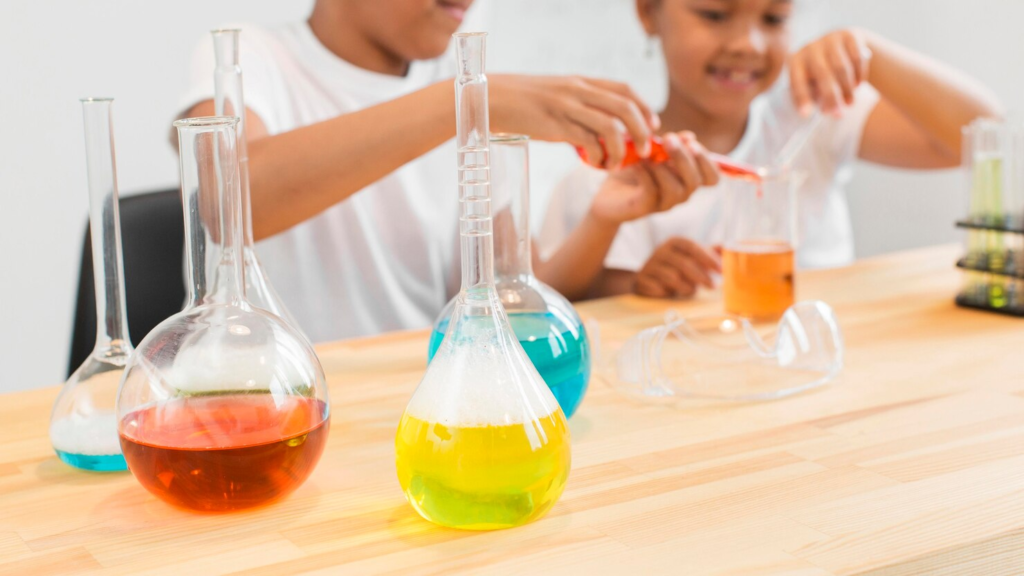
These beginner activities use safe household materials and produce dramatic, visual results that captivate young learners.
1. Baking Soda and Vinegar Volcano
What you need: baking soda, white vinegar, dish soap, food coloring, and a container
What happens: combining baking soda (a base) and vinegar (an acid) produces carbon dioxide gas, creating a fizzing, bubbling reaction
Science concept: acid-base reactions and gas production
How to do it:
- Place baking soda in your container
- Add a few drops of dish soap and food coloring
- Pour vinegar in slowly and watch the eruption
This is one of the most classic experiments for a reason — it never fails to impress and clearly demonstrates what happens when an acid meets a base.
2. Colour-Changing Milk
What you need: whole milk, food coloring (multiple colors), dish soap, a cotton swab
What happens: touching dish soap to food coloring in milk causes the colors to swirl dramatically across the surface
Science concept: surface tension and the breakdown of fat molecules
How to do it:
- Pour milk into a shallow dish
- Add drops of different food colors around the surface
- Dip a cotton swab in dish soap and touch the center — watch the colors race away
The dish soap disrupts the surface tension of the milk and breaks down fat molecules, causing movement. This experiment visually demonstrates molecular interaction in a stunning way.
3. Invisible Ink with Lemon Juice
What you need: lemon juice, a cotton swab, white paper, a light bulb, or an iron
What happens: lemon juice is nearly invisible when dry, but turns brown when heated due to oxidation
Science concept: oxidation reactions
How to do it:
- Write a message on paper using lemon juice applied with a cotton swab
- let it dry completely — the writing disappears
- hold the paper near a warm light bulb or carefully apply gentle heat — the message reappears in brown
4. Walking Water
What you need: clear cups, water, food coloring, paper towels
What happens: colored water travels from full cups to empty ones through paper towel bridges, mixing colors in between
Science concept: capillary action and color mixing
This experiment beautifully demonstrates how plants absorb water through their roots — capillary action pulling liquid upward against gravity.
Intermediate Chemistry Experiments (Ages 9–13)
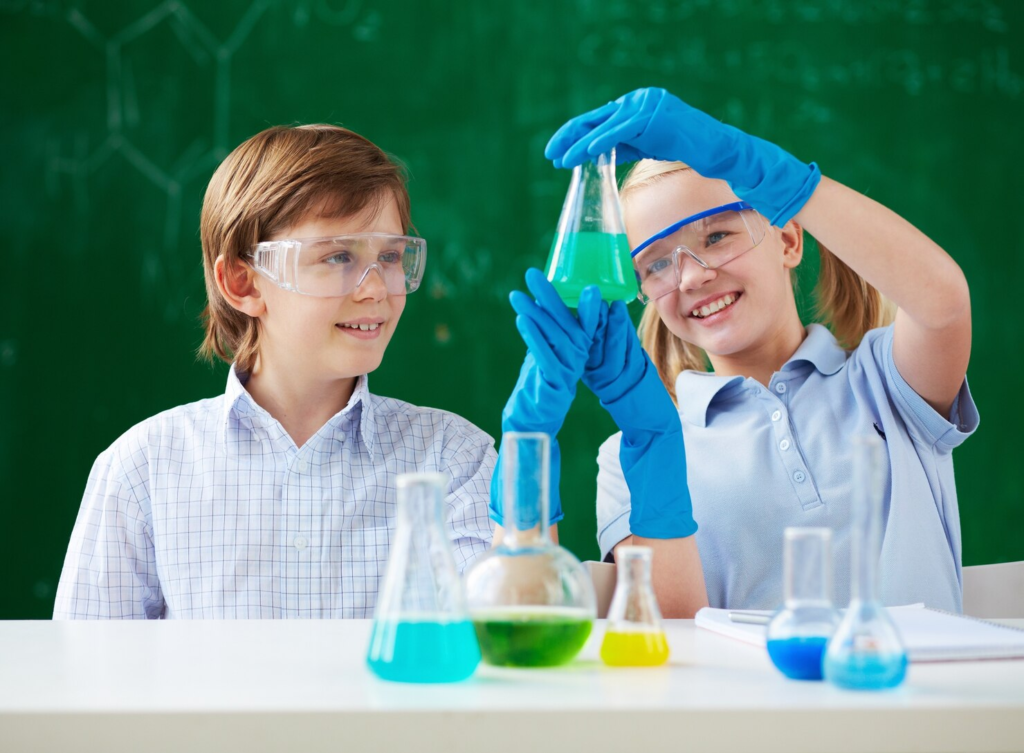
These experiments produce more dramatic results and introduce more complex scientific concepts. Adult supervision is recommended.
5. Elephant Toothpaste
What you need: 6% hydrogen peroxide, dry yeast, warm water, dish soap, food coloring, a narrow-mouthed bottle
What happens: yeast acts as a catalyst to rapidly decompose hydrogen peroxide into water and oxygen, creating a massive foam explosion
Science concept: catalytic decomposition and exothermic reactions
Important: use 6% hydrogen peroxide (available at beauty supply stores), not standard 3% drugstore variety — the reaction is significantly more impressive, and the experiment is still safe when handled correctly.
6. Red Cabbage pH Indicator
What you need: red cabbage, water, various household liquids (lemon juice, baking soda solution, vinegar, milk, bleach solution)
What happens: red cabbage juice changes color across the pH spectrum — pink in acids, green or yellow in bases, purple in neutral solutions
Science concept: pH indicators and the acid-base spectrum
How to do it:
- Boil red cabbage in water for 10 minutes to extract the purple indicator juice
- strain the liquid into clear cups
- Add different household liquids to each cup and observe the color changes
This is one of the most visually impressive experiments available with kitchen ingredients. The color range across different pH levels is genuinely striking.
7. Density Tower
What you need: honey, corn syrup, dish soap, water, vegetable oil, rubbing alcohol, food coloring, a tall clear glass
What happens: liquids of different densities layer on top of each other without mixing, creating a visible rainbow column
Science concept: density and immiscibility
The key to success is pouring each liquid very slowly down the side of the glass. The layers stay separated because denser liquids sink below less dense ones — honey at the bottom, rubbing alcohol at the top.
8. Homemade Slime
What you need: white PVA school glue, borax solution (or contact lens solution with baking soda), food coloring
What happens: the glue’s polymer chains cross-link with the borax activator, creating a non-Newtonian fluid
Science concept: polymer chemistry and non-Newtonian fluids
Slime behaves like both a liquid and a solid depending on how force is applied — a direct demonstration of non-Newtonian fluid properties that connects to real-world applications in materials science.
9. Chromatography with Markers
What you need: washable black markers, coffee filters, water, and clear cups
What happens: as water travels up the coffee filter through capillary action, it separates the ink into its component colors
Science concept: chromatography and mixture separation
Black ink is actually a mixture of multiple colors. This experiment separates them visually — a technique used in real chemistry labs to identify unknown compounds.
10. Crystal Growing
What you need: borax or alum powder, boiling water, pipe cleaners, string, pencil
What happens: as the supersaturated solution cools, crystals nucleate and grow on the pipe cleaner structure overnight
Science concept: supersaturation, nucleation, and crystallization
Advanced Chemistry Experiments (Ages 14+)
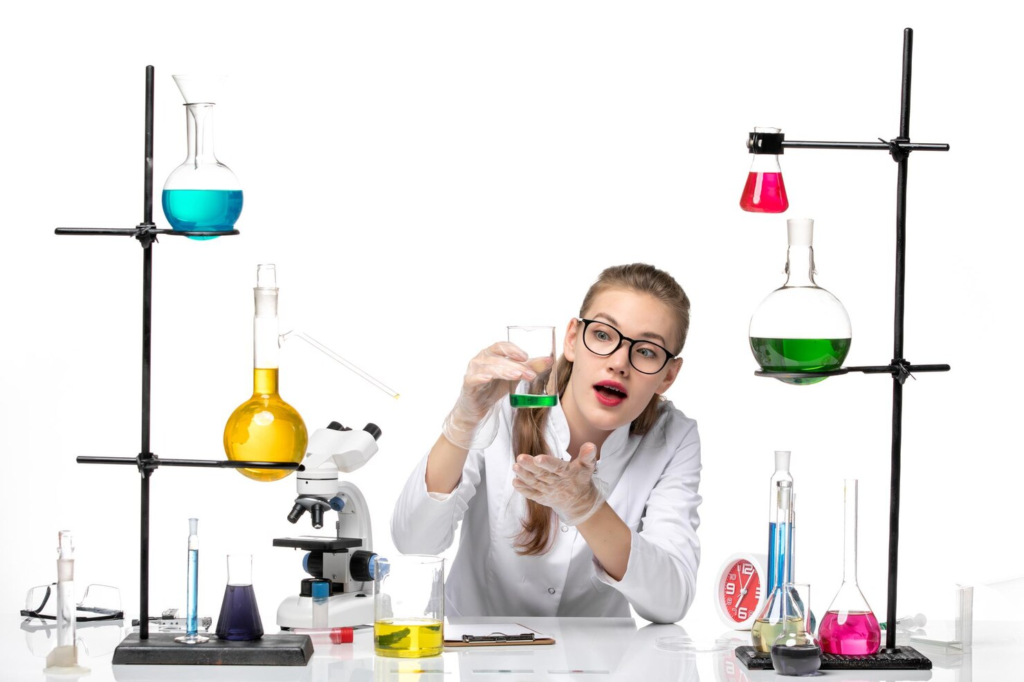
These chemistry experiments are suitable for high school students and science fair projects. All require adult supervision and careful attention to safety guidelines.
11. Electrochemistry — Copper Plating
What you need: copper sulfate solution, copper electrodes, 9V battery, wire, distilled water
What happens: electric current drives copper ions from the solution onto a metal surface, coating it in copper
Science concept: electrochemistry, oxidation, and reduction reactions
This demonstrates the same principle behind industrial metal plating used in electronics manufacturing.
12. Chemiluminescence — Homemade Glow
What you need: glow stick contents (requires cutting a glow stick carefully), hydrogen peroxide, sodium carbonate
Science concept: chemiluminescence — light produced by a chemical reaction rather than heat
13. Vinegar and Steel Wool Battery
What you need: steel wool, white vinegar, copper wire, voltmeter
What happens: vinegar removes the oxide coating from steel wool, allowing an electrochemical reaction with copper wire that generates measurable voltage
Science concept: electrochemical cells and the basis of battery technology
Chemistry Experiments for Science Fairs
Science fair chemistry experiments need to go beyond visual demonstrations. Judges look for a clear hypothesis, controlled variables, measurable results, and a genuine conclusion.
Strong science fair approaches include:
- testing which household acids most effectively remove rust from metal
- measuring how temperature affects the rate of the baking soda and vinegar reaction
- comparing the effectiveness of different natural pH indicators against red cabbage
- testing how different variables (water temperature, stirring, particle size) affect crystal growth rate
- measuring the insulating properties of different natural materials using heat transfer experiments
Also Read: Easter Coloring Pages for Kids — More Fun Activities for Young Learners
Best Resources for Chemistry Experiments
| Resource | Best For |
|---|---|
| Science Buddies | Science fair project guides with full methodology |
| Khan Academy Chemistry | Free video lessons explaining the science behind experiments |
| American Chemical Society | Professional-grade experiment guides and safety resources |
| PBS LearningMedia | Classroom-ready experiment videos and lesson plans |
Related: Is Sparx Reader Actually Effective? An Honest Look at Results
Chemistry Experiments You Can Do With Household Items Only:
One of the biggest myths about science is that you need expensive equipment to do meaningful experiments. The truth is that your kitchen contains everything required for dozens of genuine chemistry demonstrations.
Here is what your kitchen pantry already has — and what each ingredient demonstrates:
| Ingredient | Science Concept | Used In |
|---|---|---|
| Baking soda | Base chemistry, CO₂ production | Volcano, elephant toothpaste |
| White vinegar | Acid chemistry | Volcano, rust removal, battery |
| Dish soap | Surface tension, emulsification | Colour-changing milk, slime |
| Food coloring | Tracer for invisible reactions | Walking water, density tower |
| Lemon juice | Oxidation, acid indicator | Invisible ink, pH testing |
| Salt | Electrolyte, density change | Floating egg experiment |
| Red cabbage | Natural pH indicator | Acid-base spectrum testing |
| Corn starch | Non-Newtonian fluid | Oobleck — solid and liquid combined |
Bonus Experiment: Oobleck
Oobleck is one of the most fascinating kitchen chemistry experiments because it behaves as both a solid and a liquid depending on how force is applied.
What you need: corn starch, water, food coloring
Ratio: 2 parts corn starch to 1 part water
What happens: punch it hard and it feels like a solid — hold it gently and it flows like liquid
Science concept: non-Newtonian fluid behavior — the same principle behind bulletproof vest materials and industrial shock absorbers
This experiment alone can generate an entire classroom discussion about states of matter and material science.
Chemistry Experiments for Different Learning Environments:
Chemistry experiments work differently depending on where they are performed. Here is how to adapt the same experiments for three different settings.
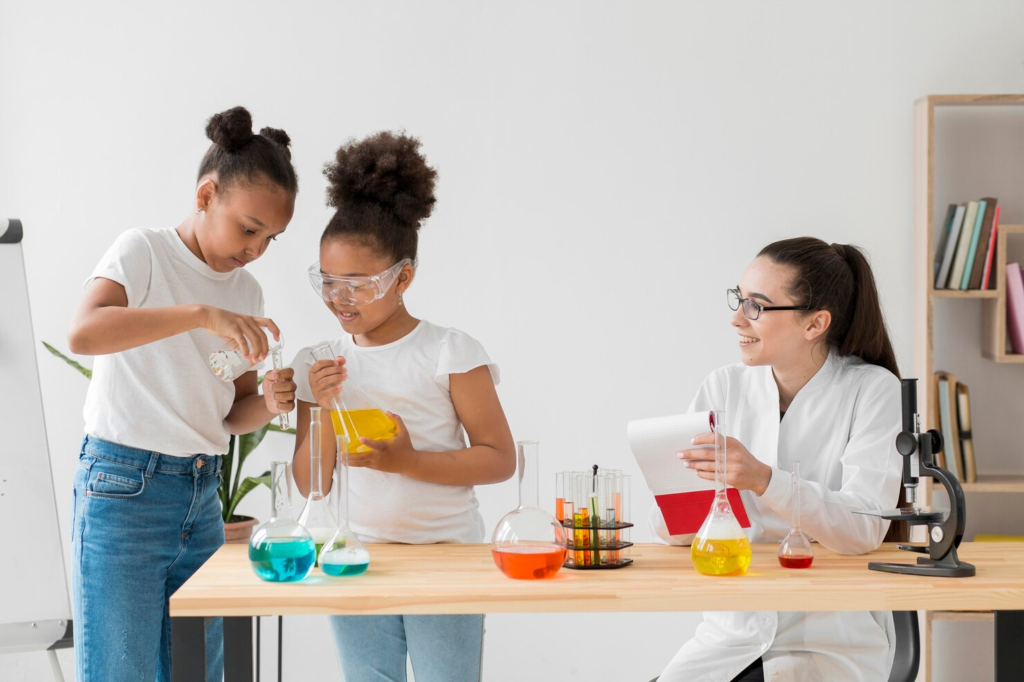
At Home
Home experiments work best when they are quick, use minimal cleanup materials, and involve the whole family. The best approach:
- prepare all materials before starting — children lose interest during setup delays
- do experiments on a wipeable surface or cover the table with newspaper
- explain what will happen before starting — anticipation increases engagement
- ask “why do you think that happened?” after every reaction
Best home experiments: baking soda volcano, colour-changing milk, invisible ink, walking water, oobleck
In the Classroom
Classroom experiments need to scale for groups and fit within a lesson period. Practical considerations:
- divide students into groups of 3-4 for resource efficiency
- use the experiment as a demonstration first, then let students replicate it
- connect every experiment to the curriculum concept being taught that week
- always have a written observation sheet — it turns an activity into a learning record
Best classroom experiments: red cabbage pH indicator, chromatography with markers, density tower, crystal growing
For Science Fairs
Science fair experiments need a testable hypothesis and measurable results. The experiment itself is secondary — the scientific method is what judges evaluate. Strong science fair structure:
- Question: What do I want to find out?
- Hypothesis: What do I predict will happen and why?
- Variables: What am I changing, what am I keeping the same, what am I measuring?
- Results: What did the data show?
- Conclusion: Was my hypothesis correct? What would I do differently?
Best science fair experiments: crystal growth rate testing, rust removal acid comparison, elephant toothpaste concentration testing
How to Document a Chemistry Experiment Properly
Most students and parents skip documentation entirely — which is a missed opportunity whether for school assignments, science fairs, or simply building scientific habits.
Proper documentation of chemistry experiments takes less than 10 minutes per experiment and significantly deepens understanding.
The Simple Experiment Log
For each experiment, record these five things:
- Date and location — when and where the experiment was performed
- Materials used — exact amounts if possible
- What you predicted — before seeing the result
- What actually happened — describe the observation in detail
- Why it happened — the science concept in your own words
Writing the “why” in your own words is the most important step. It forces genuine understanding rather than passive observation.
For Science Fair Projects
Science fair documentation requires a formal lab report structure. Most teachers and judges expect:
- title page with experiment name and student name
- abstract — a 150-200 word summary of the entire project
- introduction — background research and why the topic matters
- materials and methods — detailed enough that someone else could replicate it
- results — data tables, measurements, and observations
- discussion — what the results mean and whether the hypothesis was supported
- conclusion — summary and suggestions for future experiments
- references — sources used for background research
Chemistry Experiments by Concept — Quick Reference Guide
If you are looking for an experiment that teaches a specific chemistry concept, use this reference table:
| Chemistry Concept | Best Experiment | Age Group |
|---|---|---|
| Acid-base reactions | Baking soda and vinegar volcano | 5+ |
| pH indicators | Red cabbage pH spectrum | 9+ |
| Surface tension | Colour-changing milk | 5+ |
| Capillary action | Walking water, chromatography | 5+ |
| Density | Density tower with liquids | 9+ |
| Oxidation | Invisible lemon juice ink | 5+ |
| Polymer chemistry | Homemade slime | 9+ |
| Catalytic decomposition | Elephant toothpaste | 9+ |
| Crystallization | Crystal growing with borax | 9+ |
| Electrochemistry | Copper plating, steel wool battery | 14+ |
| Chemiluminescence | Glow stick chemistry | 14+ |
| Non-Newtonian fluids | Oobleck, slime | 6+ |
| Mixture separation | Chromatography with markers | 9+ |
| Supersaturation | Crystal growing | 9+ |
This table makes it easy for teachers to match experiments to their lesson plan and for parents to choose an experiment that reinforces what their child is learning at school.
Tips for Parents Supervising Chemistry Experiments
Parents are often the biggest barrier to home chemistry experiments — not because they are unhelpful, but because they are understandably cautious about mess, safety, and whether the activity is actually educational.
Here is what experienced science educators recommend for parents:
Let the Child Lead
Resist the urge to take over when things go wrong. A failed experiment — one that doesn’t produce the expected result — is often more educational than a successful one. Ask “what do you think went wrong?” rather than correcting the mistake immediately.
Connect to Real Life
Every experiment in this guide connects to something in the real world:
- colour-changing milk → how soap cleans dishes and clothes
- density tower → how oil spills float on ocean water
- electrochemistry → how batteries and electric cars work
- chromatography → how forensic scientists identify unknown substances
Making these connections transforms a fun activity into genuine scientific literacy.
Don’t Worry About the Mess
The experiments in this guide were specifically selected for manageable cleanup. Most require only a damp cloth and running water. A little food coloring on a surface is a small price for a child who asks “how does that work?” for the first time.
Age-Appropriate Supervision Levels
| Age Group | Supervision Level |
|---|---|
| Under 8 | Adult performs, child observes and assists |
| 8–12 | Child performs with adult present throughout |
| 12–15 | Child performs, adult available nearby |
| 15+ | Child performs independently for safe experiments; adult present for advanced ones |
Common Mistakes to Avoid
Most failed experiments come down to a small number of easily avoidable errors:
- Using the wrong concentration — the difference between 3% and 6% hydrogen peroxide produces dramatically different results in the elephant toothpaste experiment
- Skipping the slow pour — density tower experiments fail when liquids are poured too quickly and mix before settling
- Not waiting long enough — crystal growing requires patience; checking too frequently disturbs nucleation
- Using cold water for saturation — supersaturated solutions require hot water to dissolve enough material for crystal formation
- Not drying the paper first — invisible ink experiments fail if the paper is not completely dry before applying heat
Frequently Asked Questions
What are the easiest chemistry experiments to do at home?
The baking soda and vinegar reaction, colour-changing milk, and invisible lemon juice ink are the easiest chemistry experiments available. All three use materials found in any kitchen, take under 15 minutes, and produce immediate visible results. They are suitable for children as young as five with basic adult supervision.
What chemistry experiments are safe for kids?
Most kitchen-based chemistry experiments are safe for children when adult supervision is present. Safe materials include baking soda, vinegar, dish soap, food coloring, lemon juice, milk, and salt. Avoid hydrogen peroxide above 3% concentration, bleach in any form, and any experiment involving open flames for children under 12.
What chemistry experiments are best for science fairs?
The best science fair experiments are ones that test a measurable variable rather than simply demonstrate a reaction. Comparing rust removal effectiveness of different acids, testing how temperature affects reaction rate, or measuring crystal growth under different conditions all provide the data judges expect for a strong science fair entry.
Can chemistry experiments be done without special equipment?
Yes. The majority of the best require nothing beyond kitchen pantry items and basic household supplies. Measuring cups, clear glasses, and common ingredients like vinegar, baking soda, and food coloring are enough to demonstrate a wide range of fundamental chemistry concepts including acid-base reactions, density, surface tension, and capillary action.
What is the most impressive chemistry experiment for kids?
Elephant toothpaste consistently produces the most dramatic visual reaction of any accessible experiment. The foam explosion from a narrow bottle is genuinely startling and immediately raises the question of what caused it — making it both entertaining and educational. Use 6% hydrogen peroxide for the best result.
Final Thoughts
Chemistry experiments are one of the most powerful educational tools available — and the barrier to entry has never been lower. The most impressive demonstrations in this guide require nothing more than a kitchen pantry and fifteen minutes of your time.
The real value of chemistry experiments is not the reaction itself. It is the moment after the reaction — when a student, child, or curious adult asks “why did that happen?” That question is the beginning of genuine scientific thinking.
Start with the baking soda volcano or colour-changing milk if you are new to this. Work your way up to elephant toothpaste and the red cabbage pH indicator as confidence grows. And if you are preparing for a science fair, choose an experiment that lets you test a variable — not just observe a reaction.
The kitchen is your laboratory. The experiments are waiting.