
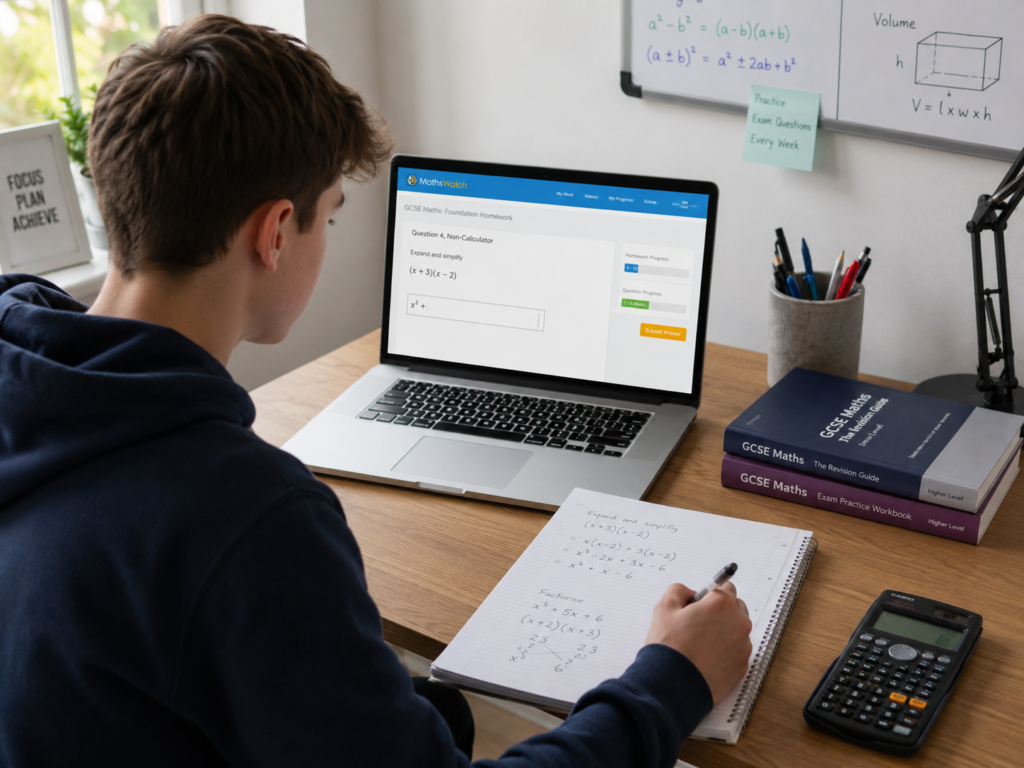
Many parents first notice a maths problem through homework. A student may be logging in, completing tasks, and still feeling unsure when exam-style questions appear in class or mocks.
Online homework can be useful because it creates routine. It gives students regular practice, helps teachers track completion, and encourages pupils to keep revisiting key skills. But for GCSE maths, homework alone is not always enough. Students also need exam-style practice, mark scheme awareness, and a way to identify which topics are costing them marks.
This guide explains how to support a child who is using Sparx Maths or another online homework platform but still needs extra GCSE revision.
Why Homework Can Feel Different From GCSE Exam Questions
A homework task usually focuses on one skill at a time. That is helpful when a student is learning a method.
GCSE exam questions can be harder because they often mix skills together. A question may begin with percentages, then require algebra, ratio, estimation or reasoning. Students may understand each individual topic but still struggle when the question is worded in an unfamiliar way.
This is why a student can complete homework but still underperform in mocks.
Signs Your Child Needs Extra Maths Support
Extra practice may be useful if your child:
Completes homework but forgets the method a week later
Gets stuck when questions are worded differently
Knows the topic in class but loses marks in tests
Avoids non-calculator questions
Leaves multi-step problems blank
Does not show working clearly
Struggles to explain why an answer is correct
Repeats the same mistakes after marking work
These are common problems. They do not always mean the student needs more hours of revision. Often, they need better-targeted practice.
How to Use Homework as a Starting Point
Instead of asking “Have you finished your homework?”, try asking:
Which questions took the longest?
Which topic felt hardest?
Did you get any questions wrong more than once?
Could you explain one question to me?
What similar exam question could you try next?
This shifts the focus from completion to understanding.
If a student is rushing homework just to submit it, slow the process down. Maths improves when students think carefully about mistakes and repeat similar questions after feedback.
Add Exam-Style Questions by Topic
A strong GCSE maths routine should include two types of practice.
First, students need skill practice. This helps them learn methods.
Second, they need exam-style questions. This helps them apply methods under realistic conditions.
A useful next step is to choose one weak topic from homework and then practise that same topic using GCSE exam questions. For example, if ratio homework was difficult, spend the next session on ratio exam questions. If simultaneous equations caused problems, practise that topic in isolation before moving back to mixed papers.
Students can use this GCSE maths past paper questions by topic tool to practise individual topics with exam questions, mark schemes, worked solutions and video walkthroughs.
A Simple Weekly Routine
Parents do not need to create a complicated revision timetable. A simple routine works better.
Monday: complete school homework carefully
Tuesday: review mistakes from homework
Wednesday: practise one related GCSE topic
Thursday: redo incorrect questions without help
Friday: attempt five mixed exam questions
Weekend: short review of the weakest topic
This routine keeps homework connected to exam preparation.
How Parents Can Help Without Being Maths Experts
You do not need to know every GCSE maths method to support revision.
You can help by:
Creating a regular study time
Asking your child to explain their working
Encouraging them to write down mistakes
Checking whether they have marked their answers
Helping them choose one topic at a time
Keeping sessions short and consistent
Praising corrected mistakes, not just correct answers
The most important habit is correction. If a student gets a question wrong and immediately moves on, the same mistake is likely to happen again. If they correct it, repeat it, and try a similar question later, progress is much more likely.
Best Topics to Prioritise for GCSE Maths
For students aiming to build confidence, start with high-value topics that appear often:
Fractions
Percentages
Ratio
Rounding and estimation
Negative numbers
Linear equations
Sequences
Substitution
Angles
Area and volume
Pythagoras
Averages
Probability
Graphs
Transformations
These topics support many other areas of GCSE maths, so improving them can have a wider impact.
Final Thoughts
Sparx Maths and similar homework platforms can help students build routine, but GCSE success usually needs more than completion. Students need to understand mistakes, revisit weak topics, and practise exam-style questions.
The best approach is simple: use homework to spot gaps, then use topic-based exam questions to close them.