
Table of Contents
CDiPhone 2026: The Viral Apple “Device” That Was Never Actually Real
If you’ve spent any time scrolling tech content lately, you’ve probably bumped into “CDiPhone” — described, depending on which article you land on, as a new Apple device, a hidden diagnostic tool, an Android phone, or a CDMA-network handset from a decade ago. During research for this piece, we checked every one of those claims against actual Apple sources. Here’s the short version: none of them is true. CDiPhone isn’t a product Apple makes, sells, or has ever announced. It’s something far more interesting than that — a viral idea that snowballed into “fact” purely because enough websites repeated it confidently, and then got amplified further by headlines specifically engineered to make you click before you’d ask whether it was real.
That second part matters as much as the myth itself. Once we started pulling up the articles ranking for this term side by side, a pattern jumped out immediately: almost every headline is built from the same handful of curiosity-gap tricks. We’ll break those down properly further down, because understanding why this spread explains a lot about how internet “facts” get manufactured in 2026.
Also Read: Acamento Explained: The Powerful Truth Behind This Growing Trend
What Is CDiPhone?
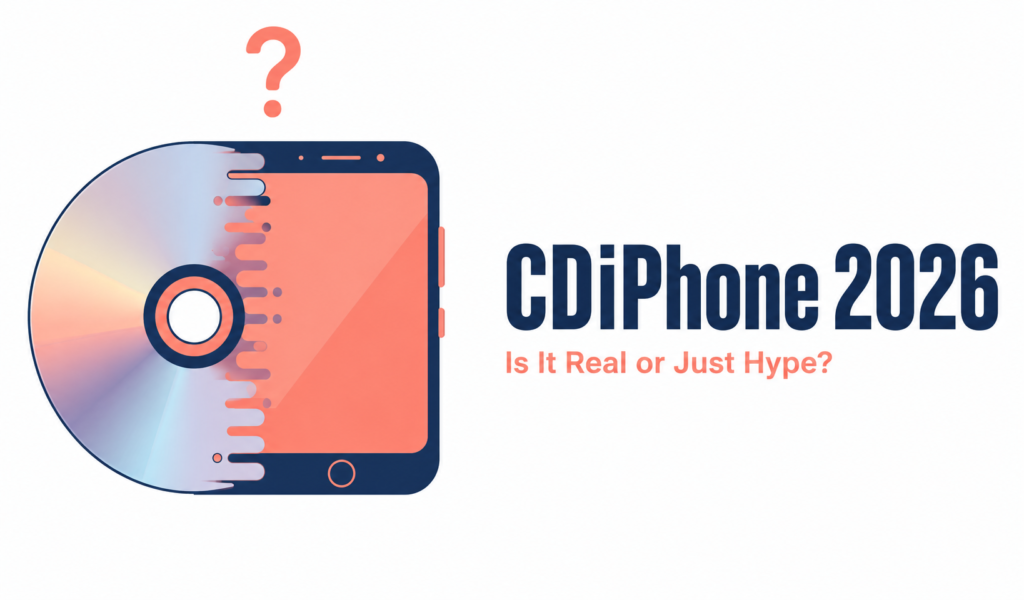
CDiPhone is a fan-made, internet-born concept imagining a device that merges a compact disc player with an iPhone. The idea: pop a CD in, and your phone somehow reads and plays it, complete with “AI file management” and oddly specific “tri-layered storage” features that nobody can quite explain the mechanics of. After researching this directly, we found Apple has made no announcement, no patent filing, no product page — nothing — referencing this name. It started as a nostalgic “what if” thought experiment and got swept up by content sites treating it as a real launch.
What makes this one stand out from the usual fake-product rumor is how detailed the fiction got. Most viral hoaxes stay vague — a blurry photo, one leaked “spec.” CDiPhone went further: separate articles invented a tri-layered storage architecture, AI-driven file categorization, specific chip names, foldable-screen dimensions, and even a fictional battery comparison. None of these details traces back to a single source. Each site added its own layer on top of whatever the last article said, which is how a rumor calcifies into something that reads like a spec sheet despite having zero footing in reality.
Why CDiPhone Became Popular?
This is the part most coverage skips, and it’s the most useful thing to understand if you want to know how a fictional product climbs search rankings. After comparing the headlines actually ranking for this term, the pattern is consistent: nearly every one is engineered around a specific curiosity-gap trigger rather than a factual claim.
Here’s what we found, broken down by the trigger each headline leans on:
- The “secret reveal” trigger — headlines like “What CDiPhone Actually Does” or phrasing that implies hidden, insider information. This works because it promises the reader knowledge that other people don’t have yet.
- The superlative trigger words like “Revolutionary,” “Ultimate,” “Game-Changer,” and “Powerful” are stacked into titles. These don’t describe anything specific; they signal “this is big” without committing to a verifiable claim.
- The incomplete-question trigger — titles phrased as “What is CDiPhone?” or “CDiPhone: Why It Doesn’t Exist,” which work because the reader can’t resolve the curiosity gap without clicking through.
- The implied-authority trigger — naming Apple directly in the headline (“Apple Innovation,” “All-in-One Apple Innovation”) to borrow credibility from a real, trusted brand, even though Apple has no connection to the actual content.
- The nostalgia trigger — leaning on CD ownership and pre-streaming music culture, which creates an emotional hook strong enough that readers click to relive a feeling, not to verify a fact.
Stack two or three of these in a single headline, and you get exactly what’s ranking right now: titles that promise a revelation, borrow Apple’s name, and tap nostalgia, all without making a single falsifiable claim you could fact-check from the headline alone. That’s not an accident — it’s a high-CTR formula, and it works just as well on a fictional product as a real one, since the click happens before the reader has any way to know the difference.
The underlying emotional hook is genuinely real, though, and it’s worth separating from the fake mechanics layered on top. People who grew up buying CDs miss that tactile, “I own this” feeling in a world of rented streaming subscriptions. That’s a real, relatable feeling — even if the product wrapped around it isn’t. Add some AI-generated concept art doing the rounds in design communities, and you have the exact recipe for a term that feels like it should be real, which is precisely why it kept spreading rather than dying out after the first article.
Where the Trend Actually Started
Tracing the true origin of a viral term like this is hard, since there’s no single announcement to point to. From what we could verify, the concept appears to trace back to online design and tech-concept communities, where digital artists were producing realistic-looking renders of a futuristic iPhone with built-in CD-reading capability. As those images circulated across forums and image-sharing platforms, more people contributed their own versions, and the back-and-forth debate over whether the design was real, possible, or even desirable gave it momentum. That’s a meaningfully different origin story than “Apple leaked something” — it’s closer to a collaborative art trend mistaken for a product rumor once text-based content sites picked it up and wrote about it as fact.
We did not find verifiable evidence tying the start to a specific platform, date, or creator, and we’d rather say that plainly than invent a tidy origin story the way several competing articles do.
What Still Works in 2026?
Give credit where it’s due: the underlying wish isn’t silly. If what you actually want is CD-quality sound or your old CD collection accessible on your iPhone, real solutions for that already exist — ripping CDs to lossless files via a computer, using a small Bluetooth CD player paired to your phone, or apps that import digitized CD audio into your music library. None of that requires a mythical Apple device. It just requires gear that already exists today.
There’s also a smaller, legitimate insight buried in the hype: retro-format revivals are a real pattern in consumer tech. Vinyl sales have climbed back from near-zero over the past two decades, and that broader “physical media nostalgia” trend is genuinely documented, even though no major phone manufacturer has rebuilt CD support into a smartphone. The instinct behind this whole trend — wanting tactile ownership alongside digital convenience — is the same instinct driving real vinyl and cassette sales today. That’s the one part with actual substance behind it.
What No Longer Works Reliably
What doesn’t hold up is everything specific being claimed about it. During research, we found wildly inconsistent technical claims across sites — one calling it an Apple internal diagnostic tool used by repair technicians, another insisting it runs on Android, another describing it as old CDMA-network hardware, and others listing brand-new specs like titanium bodies and specific Apple chip names. These can’t all be describing the same product, because there is no product. Treat any “feature list,” “spec sheet,” or “pricing” you see for it as fiction dressed up as a leak.
It’s worth walking through just how far apart these claims are, because the contradictions are the clearest proof this isn’t a real product:
- One source describes it as consumer hardware with foldable screens and titanium construction
- Another describes it as an internal Apple diagnostic tool never meant for consumers at all
- A third describes it as an Android-based device, despite the name implying an Apple product
- A fourth reinterprets it entirely as a CDMA-network iPhone variant from years ago, unrelated to compact discs
No single product can simultaneously be a brand-new foldable consumer phone, a hidden internal repair tool, an Android device, and an old network-standard handset. The fact that all four explanations are actively ranking in search results at the same time is itself the strongest evidence that none of them were ever fact-checked against a primary source before publishing.
Is CDiPhone Safe to Use?

There’s nothing to “use” here in the literal sense — it isn’t software, an app, or a jailbreak tool you can install. If you ever come across a download, APK, or “install CDiPhone” link claiming otherwise, that’s worth being cautious about, since it’s riding on a fake product name to get clicks, and that’s a pattern sometimes used to push unwanted software. Reading articles about the concept is harmless. Downloading anything claiming to be it is where we’d tell you to slow down.
Better Alternatives for Getting CDs Onto Your iPhone:
| Method | What It Actually Does | Cost |
|---|---|---|
| Rip CDs via computer + sync app | Converts CDs to digital files you can transfer to your phone | Free–low (just need a CD drive) |
| Portable Bluetooth CD player | Plays CDs and streams audio wirelessly to your iPhone | Moderate, one-time purchase |
| Digitizing service | Mail in your CDs, send back digital files | Paid per CD or per batch |
| Streaming services | Recreates much of your CD library digitally, no physical media needed | Subscription |
Is It Legal?
Yes, completely — there’s nothing illegal about the concept itself, since it’s just an idea people discuss online. The only legal caution worth mentioning is the usual one: ripping CDs you own for personal use is generally fine in most places, but distributing those files to others isn’t. None of that is unique to this trend; it’s just standard copyright common sense.
Should You Still Search for It?
If you’re hoping to buy an actual CDiPhone, no — there’s nothing to buy. If you’re chasing the feeling behind the trend, yes, that’s worth pursuing, through the real tools above instead of waiting on a device that was never coming.
Frequently Asked Questions
Is CDiPhone a real Apple product?
No. Apple has never announced, patented, or sold anything by this name. It’s a fan-made viral concept.
What does CDiPhone actually mean, then?
It started as a nostalgic concept imagining a CD player built into an iPhone, then spread across content sites with increasingly invented “details” added on top.
Is CDiPhone a diagnostic tool used by Apple technicians?
We found this claim on a few forum threads, but no official Apple source confirms it. It appears to be another guess layered onto an already-fictional term.
Can I actually play CDs on my iPhone somehow?
Not directly — iPhones don’t have CD drives. But you can rip your CDs to digital files on a computer first, or use a Bluetooth CD player alongside your phone.
Is it safe to download something called “CDiPhone”?
Be cautious. Since no real product exists, anything offered for download under this name isn’t an official Apple release and should be treated with the same skepticism as any unverified app.
Why do so many articles about CDiPhone contradict each other?
Because each one is filling in details for a product that doesn’t exist, with no original source to check against. Once one site adds a fictional spec, others tend to repeat or build on it rather than verify it from scratch.
How do I spot this kind of fake-product trend in the future?
Watch for headlines stacking superlatives (“Revolutionary,” “Game-Changer”) with a real brand name attached, paired with vague feature claims you can’t independently verify on the brand’s actual website. If a major company supposedly launched something and there’s no official announcement anywhere on their own channels, that’s the clearest signal.
Final Thoughts
CDiPhone is a good reminder of how fast an internet idea can start looking like a real product, just because enough sites repeat it with confidence — and how much a well-engineered headline can do the heavy lifting in making that happen. There’s no device to buy, no diagnostic tool to unlock, and no Android version hiding under an Apple name. What’s real is the nostalgia behind it, and the genuine pattern of physical-media revival in consumer culture — and that part, at least, you can actually act on with tools that already exist today.